


International Sustainability & Carbon Certification

Standard Overview
International Sustainability & Carbon Certification (ISCC) is a globally recognized certification system that ensures sustainable, deforestation-free, and traceable supply chains for a wide range of sustainable feedstocks, including agricultural biomass, biogenic wastes, non-biological renewable materials, and recycled carbon-based materials.
It verifies compliance with environmental, social, and economic sustainability requirements, supporting the transition to a circular economy and reducing carbon footprints.

Standard Owner
International Sustainability and Carbon Certification (ISCC) is an independent multi-stakeholder initiative governed by ISCC System GmbH.
This organization is responsible for the development, surveillance, revision, and continuous improvement of the ISCC certification system.
For more detail, please visit ISCC website.
Recognition
QSI has been recognized by ISCC for ISCC EU, ISCC PLUS,
and ISCC Japan FIT certification scopes.
QSI has been recognized by ISCC for ISCC CORSIA certification scope.
Certification Programs

ISCC Japan FIT
Learn More
To incorporate the Japanese Feed-in-Tariff (FIT) system by Japan’s Ministry of Economy, Trade, and Industry (METI), ensuring that products certified under this standard qualify for the system.
To incorporate the Japanese Feed-in-Tariff (FIT) system by Japan’s Ministry of Economy, Trade, and Industry (METI), ensuring that products certified under this standard qualify for the system.

ISCC CORSIA
Learn More
Developed to demonstrate compliance with the Carbon Offsetting and Reduction Scheme for International Aviation (CORSIA) requirements for sustainable aviation fuels.
Developed to demonstrate compliance with the Carbon Offsetting and Reduction Scheme for International Aviation (CORSIA) requirements for sustainable aviation fuels.
ISCC PLUS
Learn More
Applicable for the bioeconomy and circular economy for food, feed, chemicals, plastics, packaging, textiles, and renewable feedstock derived from a process using renewable energy sources.
Applicable for the bioeconomy and circular economy for food, feed, chemicals, plastics, packaging, textiles, and renewable feedstock derived from a process using renewable energy sources.

ISCC EU
Learn More
Designed to verify compliance with the sustainability and greenhouse gas (GHG) emission savings criteria set forth by the European Union’s Renewable Energy Directive (RED III).
Designed to verify compliance with the sustainability and greenhouse gas (GHG) emission savings criteria set forth by the European Union’s Renewable Energy Directive (RED III).


Explore Common Topics and Answers
Find answers to our commonly asked questions about the services we provide. If you require further information, please contact us.
To obtain the ISCC certificate you must have an agreement with one of recognized CB by ISCC.
With the agreement, you must be registered and approved by ISCC to be an ISCC system user. If you have been granted a registration approval from ISCC, the audit can be conducted.
The ISCC certificate will be awarded upon successful audit result. For applying the ISCC certification you can refer to the link ISCC – PT Qualitas Sertifikasi Indonesia.
- Biofuels and Renewable Energy: Bioethanol, Biodiesel, Biogas, Renewable energy;
- Agricultural Products and Feedstocks: Oilseeds (e.g., palm oil, soybean, rapeseed), Sugarcane and other crops, Wheat, Corn, and Rice;
- Forestry and Forest Products: Wood and wood-based products, Timber and pulp;
- Waste and Residues: Waste oils, Food waste, agricultural residues, and organic waste;
- Textiles and Bioplastics: Bioplastics, Sustainable fibers;
- Food and Feed Industry: Sustainable food production, Animal feed;
- Circular Economy and Recycling: Recycling of materials.
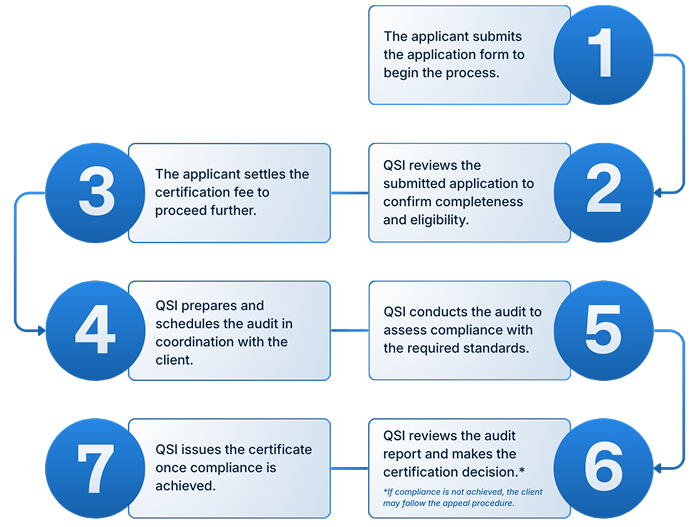
After submitting the application form to PT QSI, the technical reviewer will evaluate the application form. If the information on the application form is considered sufficient, the next step will be an agreement. With the signed agreement from both us and you, you can register to ISCC as the ISCC system user.
- All requirements of ISCC must be complied;
- The recertification audit (annually) must be participated with successful result;
- Participating in the recertification audit in due time.
You are required to inform the CB during the validity of the certificate the scope you intend to be extended. You are able to extend a certification scope during surveillance or recertification audit.
You are required to inform the CB during the validity of the certificate the scope you intend to drop. You are able to drop a certification scope during surveillance or recertification audit.
Depending on the severity of a detected non-conformity to ISCC requirements, the status of a certificate can be changed; i.e. a certificate can be suspended or withdrawn.
- Engaging to a CB;
- Registering to ISCC as ISCC system user;
- Participating in ISCC audit with positive result;
- Compliance to the ISCC requirements.
This highly depends on what you already have in place and how fast you are prepared for the audit.
ISCC certification process depends on the scope, the complexity of the units certified, and the NCs closure if applicable.
The cost depends on the scope and services proposed.
Our services cover:
- ISCC EU;
- ISCC PLUS;
- ISCC CORSIA
- ISCC Japan FIT
Yes, ISCC can certify several waste and residues including used-cooking oil (UCO) and palm oil mill effluent (POME) oil.
Because ISCC certificates allow your company to participate as an integral member of a RED certified sustainable supply chain for the European sustainable market.
Yes, this is possible. We will decide if an additional audit is necessary or not. The updated documents will be sent to ISCC and the new certificate uploaded on the ISCC website.
For an initial audit you need to prepare templates and other documents (please see check list in client section on ISCC website). Please note that the receipt of sustainable material is only possible if the recipient has a valid certificate (ISCC System Document 203, chapter 3.3.2).
The validity of the ISCC certificate is one year – precondition is the successful audit.